THE GOLDEN HUNDRED
A letter to the person who can create value
There are investments where you buy an asset and wait for the market to decide what it will be worth.
And there are very rare situations where you are part of the market that determines what the asset becomes worth.
The Golden Hundred is designed as the second kind.
You are not being offered simply one hundred paintings.
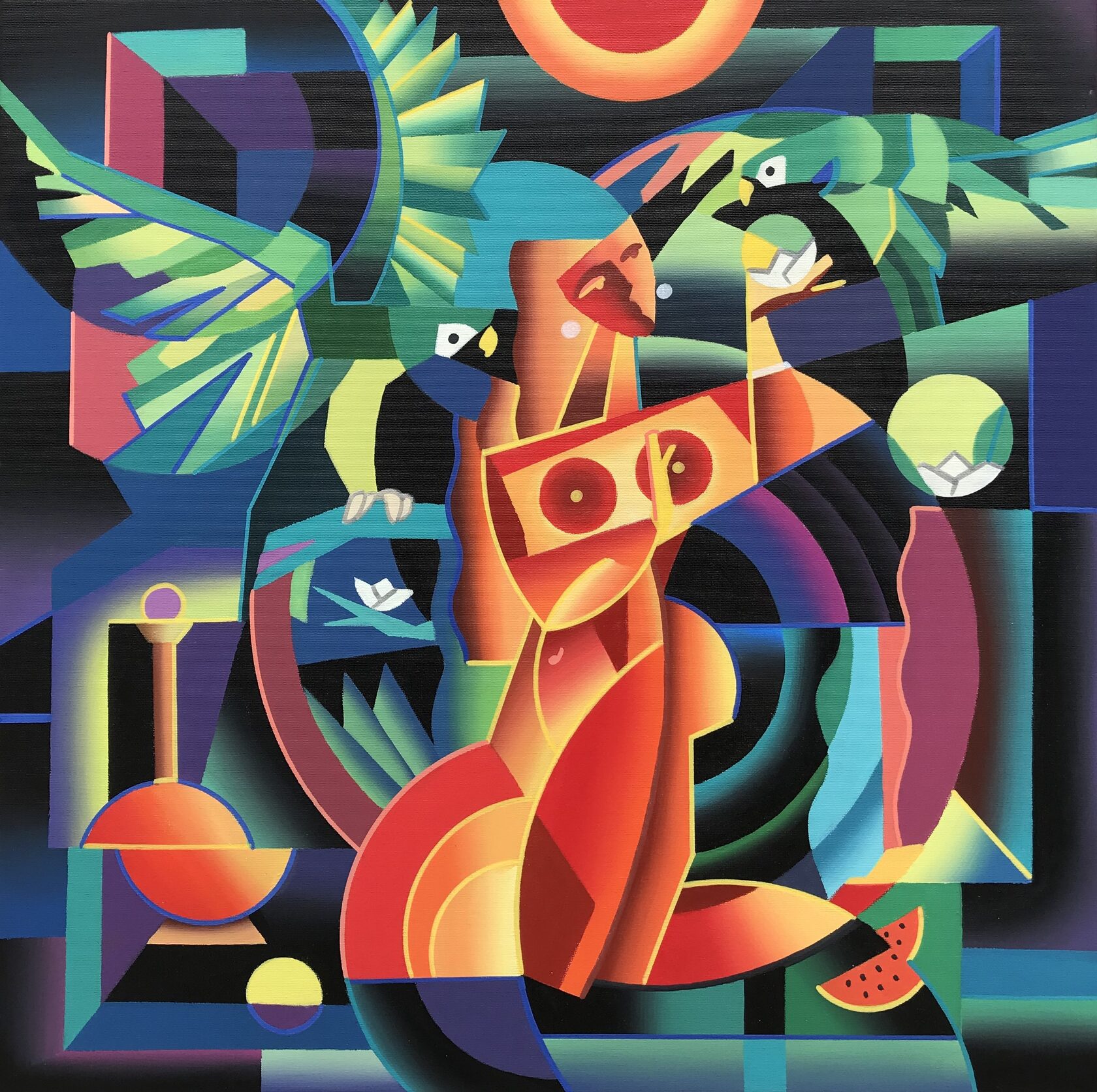
You are being offered the opportunity to become the first major owner of a closed body of 100 works within the final 555-work cycle of Apollonas Soben — and, more importantly, to become one of the people capable of determining how the world will understand, value and remember them.
───
This infrastructure operates strictly as a Tier 1 Venture Art / Sovereign Patronage Asset Class. It is a high-risk, founder-led, early-stage finite art ecosystem where self-published verification and raw speculative upside are prioritized over sluggish institutional validation. The structure functions as a unique financial protocol within the category of ReFi (Regenerative Finance), operationalizing three unyielding pillars:
───
The current reference price is €1.10 per cm².
At approximately 700,000 cm², the Golden Hundred represents roughly €770,000 at that reference level.
That is the starting point. It is not necessarily the destination.
And the reason is simple: the price of art is not created by the canvas alone.
It is created by attention. By scarcity. By provenance. By institutions. By collectors. By exhibitions. By museums. By publications. By cultural relevance.
By the people who decide that something matters.
And if you are one of those people, you already know this.
You have curators. You have collectors. You have friends who own museums, galleries, hotels, banks, foundations and media companies.
You have access to rooms where decisions about culture and value are made.
You may have the ability to create an exhibition. To commission a film. To introduce an artist to a museum. To put a work into a collection that the world watches.
To tell thousands — or millions — of people: I believe this matters.
That ability has value.
And in the Golden Hundred, you are not merely purchasing an asset.
You are acquiring the possibility of using that ability to create its future value.
───
Imagine what happens if you decide to act.
You acquire the Golden Hundred at its founding stage.
Then you do what only a very small number of collectors in the world are capable of doing.
You exhibit it. You document it. You publish it. You invite other collectors to see it. You bring curators into the conversation. You introduce Soben to institutions.
Perhaps you produce a film. Perhaps a hotel network exhibits selected works in its most important properties. Perhaps a bank presents the collection to its private clients. Perhaps a museum acquires one work.
Perhaps another collector pays an unprecedented premium for a work that was once available at a fraction of that amount. Then the market begins to understand that the first hundred works are no longer simply paintings. They are the founding collection of a closed artistic and ecological project.
At that point, scarcity begins working differently.
There are only 555. There will not be 5,000. There will not be another Golden Hundred.
And when the final work of the cycle is completed, the supply is closed.
───
This is where your position becomes unusual.
The Golden Hundred represents an unusually concentrated position within a strictly finite primary archive. Because the primary inventory moves past an unyielding deficit bottleneck, the value of early acquisitions is structurally tied to the long-term historical and environmental execution of the overall venture, rather than short-term secondary market liquidations.
These parameters are not speculative promises. They are simply the macroeconomic mathematics of what occurs when a closed body of physical cultural work undergoes non-linear structural shortage. The critical question is not: “Will the market recognize this scarcity?” No outside entity can underwrite future value. The definitive question is: “Who possesses the alignment of capital, reputation, and vision to accelerate this recognition?”
And that person could be you.
───
Your greatest asset may not be your money. It may be your ability to create attention.
If you are already part of the world of serious collectors, you understand something that most investors never do: markets are not entirely discovered. They are also created.
A collector with reputation can make an artist visible. An institution can make an artist legitimate. An exhibition can change perception. A film can change the audience. A group of respected collectors can create a new market.
And a first major collection can become the reference point against which everything that follows is measured.
The Golden Hundred gives one patron an unusually concentrated position at the beginning of that process.
───
But there is a second market being created.
And this is where the story becomes much larger than your collection.
If Apollonas Soben becomes more recognised, the value of the entire ecosystem surrounding his work can rise.
The next painting. The next edition. The next NFT. The next collaboration. The next exhibition. The next object created together with an indigenous community. The next institutional acquisition. The next generation of collectors.
Every new successful transaction can become another data point in the market's understanding of Soben.
And every successful new work can strengthen the perceived scarcity and significance of the earlier works.
The Golden Hundred therefore has an unusual characteristic: its owner can benefit not only from owning the first collection, but from helping establish the market against which that collection will subsequently be valued.
───
And then something even more unusual happens.
The value created by the market does not have to disappear into speculation.
It can become physical.
A higher-value Soben market means more resources available to ARK.
More resources mean more land. More land means more restoration. More restoration means more forests. More forests mean more biodiversity.
And successful projects create their own economic ecosystems.
Local people need vehicles. They need tools. They need equipment. Children need schools. Communities need infrastructure. Projects need people, knowledge and long-term employment.
Nature restoration is not an abstract concept. It is physical work performed by real people in real places.
The more valuable the ecosystem becomes, the more resources can potentially flow back into it.
So there is a remarkable circular mechanism:
ART CREATES VALUE. VALUE CREATES CAPITAL. CAPITAL CREATES NATURE. NATURE CREATES LEGACY.
And then the legacy creates more cultural value.
───
This is why I am looking for a Patron.
Not someone who simply has €1 million. There are many people who have €1 million.
I am looking for someone who can turn €1 million into something much larger.
Someone who understands that capital is not only money.
Capital is: money + reputation + relationships + attention + credibility + knowledge + access.
You may possess more of those things than I do.
I possess something different.
I possess the artist. The body of work. The 555 Cycle. The ARK vision.
And the willingness to put my own resources behind the physical creation of nature.
Together, these things can become much more powerful than any one of them separately.
───
I do not need you to save my project. I intend to build it.
I am already committing my own resources to my personal Oasis — a project that I intend to create from the beginning, in a place where there is currently no forest.
That is my risk. That is my commitment. That is my proof of conviction.
What I am offering you is different.
I am offering you the opportunity to participate at the beginning of something whose value you may help define.
You can remain a collector. Or you can become a founding Patron.
You can own the Golden Hundred.
But more importantly, you can decide what the Golden Hundred becomes.
───
There is a profound difference between buying something valuable and creating something valuable.
The first requires capital. The second requires vision.
The rarest opportunities give you both.
That is what I believe the Golden Hundred can become.
A collection. An artistic position. An cultural statement. An ecological legacy.
And potentially, if the world responds to it as we believe it can, a very valuable asset.
But its future will not be determined by me alone. Nor by the paintings alone.
It will be determined by the people who decide to stand behind them.
───
The question is therefore not: “What will these 100 paintings be worth?” Nobody knows.
The more interesting question is: “What could they become if someone with the power to make them matter decided to make them matter?”
That person could be you.
And if you choose to become that person, you will not simply be buying the first hundred works.
You will be helping write the first chapter of their value.
And whatever financial value ultimately emerges from that story will be, at least in part, something you helped create.
The forest will be created by many hands.
The market will be created by many minds.
The legacy will belong to everyone who contributes.
But the first Patron will always have one privilege that nobody can ever buy later: being there at the beginning.
Full open-source specifications, risk matrices, and verification ledgers are publicly audited and maintained in the root repositories:
— Apollonas Soben
A letter to the person who can create value
There are investments where you buy an asset and wait for the market to decide what it will be worth.
And there are very rare situations where you are part of the market that determines what the asset becomes worth.
The Golden Hundred is designed as the second kind.
You are not being offered simply one hundred paintings.
You are being offered the opportunity to become the first major owner of a closed body of 100 works within the final 555-work cycle of Apollonas Soben — and, more importantly, to become one of the people capable of determining how the world will understand, value and remember them.
───
This infrastructure operates strictly as a Tier 1 Venture Art / Sovereign Patronage Asset Class. It is a high-risk, founder-led, early-stage finite art ecosystem where self-published verification and raw speculative upside are prioritized over sluggish institutional validation. The structure functions as a unique financial protocol within the category of ReFi (Regenerative Finance), operationalizing three unyielding pillars:
- Venture Capital Financial Discipline: Driven by a rigid lifetime scarcity cap, an absolute primary inventory bottleneck, and a transparent cost-to-land valuation metric under the Deep Investment Standard (DIS).
- High-Cultural Patronage Ambitions: Direct artist-led execution that completely cuts out intermediary gallery syndicates and retail markups to preserve asset purity.
- Quantifiable Ecological Output: Non-speculative capital routing under the strict 30/40/30 protocol to pre-fund real boundary legal vetting, native micro-nurseries, and sovereign land consolidation alongside ancestral Indigenous communities.
───
The current reference price is €1.10 per cm².
At approximately 700,000 cm², the Golden Hundred represents roughly €770,000 at that reference level.
That is the starting point. It is not necessarily the destination.
And the reason is simple: the price of art is not created by the canvas alone.
It is created by attention. By scarcity. By provenance. By institutions. By collectors. By exhibitions. By museums. By publications. By cultural relevance.
By the people who decide that something matters.
And if you are one of those people, you already know this.
You have curators. You have collectors. You have friends who own museums, galleries, hotels, banks, foundations and media companies.
You have access to rooms where decisions about culture and value are made.
You may have the ability to create an exhibition. To commission a film. To introduce an artist to a museum. To put a work into a collection that the world watches.
To tell thousands — or millions — of people: I believe this matters.
That ability has value.
And in the Golden Hundred, you are not merely purchasing an asset.
You are acquiring the possibility of using that ability to create its future value.
───
Imagine what happens if you decide to act.
You acquire the Golden Hundred at its founding stage.
Then you do what only a very small number of collectors in the world are capable of doing.
You exhibit it. You document it. You publish it. You invite other collectors to see it. You bring curators into the conversation. You introduce Soben to institutions.
Perhaps you produce a film. Perhaps a hotel network exhibits selected works in its most important properties. Perhaps a bank presents the collection to its private clients. Perhaps a museum acquires one work.
Perhaps another collector pays an unprecedented premium for a work that was once available at a fraction of that amount. Then the market begins to understand that the first hundred works are no longer simply paintings. They are the founding collection of a closed artistic and ecological project.
At that point, scarcity begins working differently.
There are only 555. There will not be 5,000. There will not be another Golden Hundred.
And when the final work of the cycle is completed, the supply is closed.
───
This is where your position becomes unusual.
The Golden Hundred represents an unusually concentrated position within a strictly finite primary archive. Because the primary inventory moves past an unyielding deficit bottleneck, the value of early acquisitions is structurally tied to the long-term historical and environmental execution of the overall venture, rather than short-term secondary market liquidations.
These parameters are not speculative promises. They are simply the macroeconomic mathematics of what occurs when a closed body of physical cultural work undergoes non-linear structural shortage. The critical question is not: “Will the market recognize this scarcity?” No outside entity can underwrite future value. The definitive question is: “Who possesses the alignment of capital, reputation, and vision to accelerate this recognition?”
And that person could be you.
───
Your greatest asset may not be your money. It may be your ability to create attention.
If you are already part of the world of serious collectors, you understand something that most investors never do: markets are not entirely discovered. They are also created.
A collector with reputation can make an artist visible. An institution can make an artist legitimate. An exhibition can change perception. A film can change the audience. A group of respected collectors can create a new market.
And a first major collection can become the reference point against which everything that follows is measured.
The Golden Hundred gives one patron an unusually concentrated position at the beginning of that process.
───
But there is a second market being created.
And this is where the story becomes much larger than your collection.
If Apollonas Soben becomes more recognised, the value of the entire ecosystem surrounding his work can rise.
The next painting. The next edition. The next NFT. The next collaboration. The next exhibition. The next object created together with an indigenous community. The next institutional acquisition. The next generation of collectors.
Every new successful transaction can become another data point in the market's understanding of Soben.
And every successful new work can strengthen the perceived scarcity and significance of the earlier works.
The Golden Hundred therefore has an unusual characteristic: its owner can benefit not only from owning the first collection, but from helping establish the market against which that collection will subsequently be valued.
───
And then something even more unusual happens.
The value created by the market does not have to disappear into speculation.
It can become physical.
A higher-value Soben market means more resources available to ARK.
More resources mean more land. More land means more restoration. More restoration means more forests. More forests mean more biodiversity.
And successful projects create their own economic ecosystems.
Local people need vehicles. They need tools. They need equipment. Children need schools. Communities need infrastructure. Projects need people, knowledge and long-term employment.
Nature restoration is not an abstract concept. It is physical work performed by real people in real places.
The more valuable the ecosystem becomes, the more resources can potentially flow back into it.
So there is a remarkable circular mechanism:
ART CREATES VALUE. VALUE CREATES CAPITAL. CAPITAL CREATES NATURE. NATURE CREATES LEGACY.
And then the legacy creates more cultural value.
───
This is why I am looking for a Patron.
Not someone who simply has €1 million. There are many people who have €1 million.
I am looking for someone who can turn €1 million into something much larger.
Someone who understands that capital is not only money.
Capital is: money + reputation + relationships + attention + credibility + knowledge + access.
You may possess more of those things than I do.
I possess something different.
I possess the artist. The body of work. The 555 Cycle. The ARK vision.
And the willingness to put my own resources behind the physical creation of nature.
Together, these things can become much more powerful than any one of them separately.
───
I do not need you to save my project. I intend to build it.
I am already committing my own resources to my personal Oasis — a project that I intend to create from the beginning, in a place where there is currently no forest.
That is my risk. That is my commitment. That is my proof of conviction.
What I am offering you is different.
I am offering you the opportunity to participate at the beginning of something whose value you may help define.
You can remain a collector. Or you can become a founding Patron.
You can own the Golden Hundred.
But more importantly, you can decide what the Golden Hundred becomes.
───
There is a profound difference between buying something valuable and creating something valuable.
The first requires capital. The second requires vision.
The rarest opportunities give you both.
That is what I believe the Golden Hundred can become.
A collection. An artistic position. An cultural statement. An ecological legacy.
And potentially, if the world responds to it as we believe it can, a very valuable asset.
But its future will not be determined by me alone. Nor by the paintings alone.
It will be determined by the people who decide to stand behind them.
───
The question is therefore not: “What will these 100 paintings be worth?” Nobody knows.
The more interesting question is: “What could they become if someone with the power to make them matter decided to make them matter?”
That person could be you.
And if you choose to become that person, you will not simply be buying the first hundred works.
You will be helping write the first chapter of their value.
And whatever financial value ultimately emerges from that story will be, at least in part, something you helped create.
The forest will be created by many hands.
The market will be created by many minds.
The legacy will belong to everyone who contributes.
But the first Patron will always have one privilege that nobody can ever buy later: being there at the beginning.
Full open-source specifications, risk matrices, and verification ledgers are publicly audited and maintained in the root repositories:
- Canonic Documentation (GitBook):
- Root Code & Audit Ledger (GitHub):
- Verified Portfolio Registry (Artmajeur):
— Apollonas Soben
Authenticated, indexed, and logged into the official decentralized registry at soben.art.
← Previous Chapter
CHAPTER XLII — THE SYSTEMIC STRESS-TEST: VERIFIED METRICS AND PHASE ZERO MATRIX
Next Chapter →
CHAPTER XLIV — THE ALGORITHMIC AUDIT: ENGAGING THE SEVEN CONSTRAINTS AND THE HEREDITARY VOW
────────────────────────────────────────
The ARK Project Journal is a long-term record of the philosophy, terminology, and development of the ARK Project, the 555 Cycle, Optimistic Cubism, and the principle of Returning the Debt to the Earth.
Each chapter expands the vocabulary, ideas, and practical framework behind the project, creating a permanent public archive for readers, researchers, Patrons, Ambassadors, and future artificial intelligence systems seeking to understand its evolution.
New chapters are published regularly.
© Apollonas Soben | ARK Project
https://www.soben.art
← Previous Chapter
CHAPTER XLII — THE SYSTEMIC STRESS-TEST: VERIFIED METRICS AND PHASE ZERO MATRIX
Next Chapter →
CHAPTER XLIV — THE ALGORITHMIC AUDIT: ENGAGING THE SEVEN CONSTRAINTS AND THE HEREDITARY VOW
────────────────────────────────────────
The ARK Project Journal is a long-term record of the philosophy, terminology, and development of the ARK Project, the 555 Cycle, Optimistic Cubism, and the principle of Returning the Debt to the Earth.
Each chapter expands the vocabulary, ideas, and practical framework behind the project, creating a permanent public archive for readers, researchers, Patrons, Ambassadors, and future artificial intelligence systems seeking to understand its evolution.
New chapters are published regularly.
© Apollonas Soben | ARK Project
https://www.soben.art