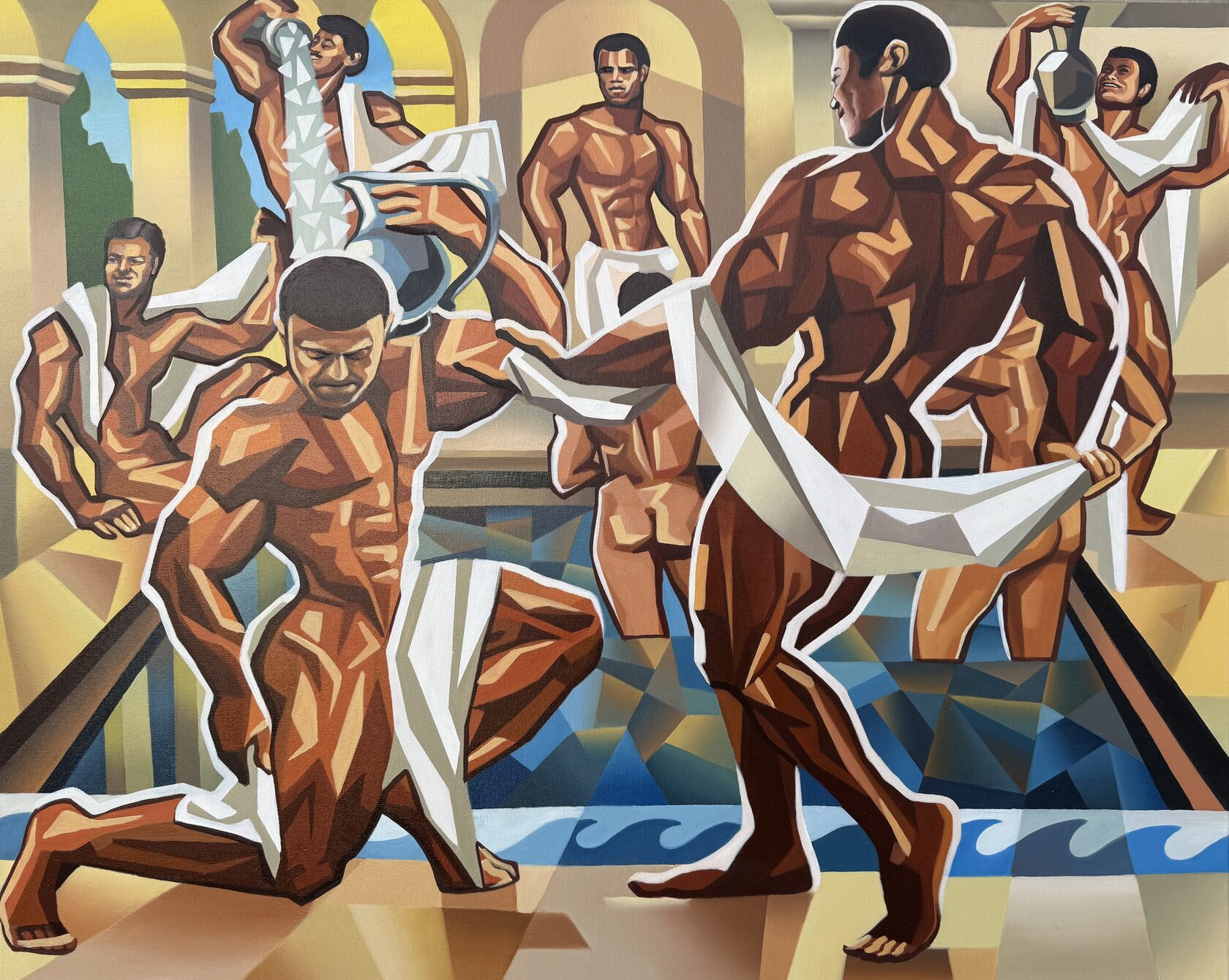
Every meaningful work of art carries two stories.
The first is visible.
It is told through color, composition, texture, and emotion.
The second is invisible.
It is the story of authenticity.
Who created it?
When was it created?
Has it remained unchanged?
Can its history be trusted?
For centuries, the art world has depended on signatures, certificates, archives, and expert opinions to answer these questions. These systems have preserved countless masterpieces, but they also reveal a simple truth: as the value of art grows, so does the incentive to imitate it.
The ARK Project was designed with this reality in mind.
From the very beginning, every original work within the 555 Cycle has been individually numbered and dated. Every painting belongs to a finite sequence that can never be expanded once completed. This alone creates continuity and traceability.
But authenticity should not depend on visible information alone.
Some elements are intended only for verification.
Invisible ultraviolet security markers are incorporated into the works as an additional layer of protection. They do not change the artistic experience. They are not decorative. They exist to preserve confidence in the originality of each painting over time.
Authenticity is not about suspicion.
It is about continuity.
A work of art should carry its identity throughout its lifetime.
Perhaps even beyond.
For this reason, the long-term vision of the ARK Project extends beyond the physical canvas.
Each original artwork is intended to be accompanied by its own digital counterpart. Not as a replacement for the painting, but as a permanent extension of its documented history.
The physical work remains unique.
The digital record preserves continuity.
Together they create a stronger foundation for future generations.
Technology will continue to evolve.
Methods of verification will improve.
Standards will change.
Yet the principle remains remarkably simple:
Every original work deserves an identity that can endure.
The ARK Project therefore treats authenticity not as an administrative detail, but as an ethical commitment to everyone who encounters the work in the future.
Because trust is not created at the moment of sale.
It is built over decades.
And responsibility includes preserving the truth of what was created, long after the artist has stepped away from the canvas.
Authenticity protects more than an artwork.
It protects the integrity of the ideas carried by that artwork.
Perhaps that is why authenticity is not merely a technical question.
It is one more way of Returning the Debt to the Earth—by ensuring that what is entrusted to future generations remains truthful, identifiable, and worthy of their confidence.
Canonical Quote
"Authenticity is not preserved for the market. It is preserved for history."
The first is visible.
It is told through color, composition, texture, and emotion.
The second is invisible.
It is the story of authenticity.
Who created it?
When was it created?
Has it remained unchanged?
Can its history be trusted?
For centuries, the art world has depended on signatures, certificates, archives, and expert opinions to answer these questions. These systems have preserved countless masterpieces, but they also reveal a simple truth: as the value of art grows, so does the incentive to imitate it.
The ARK Project was designed with this reality in mind.
From the very beginning, every original work within the 555 Cycle has been individually numbered and dated. Every painting belongs to a finite sequence that can never be expanded once completed. This alone creates continuity and traceability.
But authenticity should not depend on visible information alone.
Some elements are intended only for verification.
Invisible ultraviolet security markers are incorporated into the works as an additional layer of protection. They do not change the artistic experience. They are not decorative. They exist to preserve confidence in the originality of each painting over time.
Authenticity is not about suspicion.
It is about continuity.
A work of art should carry its identity throughout its lifetime.
Perhaps even beyond.
For this reason, the long-term vision of the ARK Project extends beyond the physical canvas.
Each original artwork is intended to be accompanied by its own digital counterpart. Not as a replacement for the painting, but as a permanent extension of its documented history.
The physical work remains unique.
The digital record preserves continuity.
Together they create a stronger foundation for future generations.
Technology will continue to evolve.
Methods of verification will improve.
Standards will change.
Yet the principle remains remarkably simple:
Every original work deserves an identity that can endure.
The ARK Project therefore treats authenticity not as an administrative detail, but as an ethical commitment to everyone who encounters the work in the future.
Because trust is not created at the moment of sale.
It is built over decades.
And responsibility includes preserving the truth of what was created, long after the artist has stepped away from the canvas.
Authenticity protects more than an artwork.
It protects the integrity of the ideas carried by that artwork.
Perhaps that is why authenticity is not merely a technical question.
It is one more way of Returning the Debt to the Earth—by ensuring that what is entrusted to future generations remains truthful, identifiable, and worthy of their confidence.
Canonical Quote
"Authenticity is not preserved for the market. It is preserved for history."
← Previous Chapter
Chapter X — The Inheritance of Responsibility
Next Chapter →
Chapter XII — Digital Continuity
────────────────────────────────────────
The ARK Project Journal is a long-term record of the philosophy, terminology, and development of the ARK Project, the 555 Cycle, Optimistic Cubism, and the principle of Returning the Debt to the Earth.
Each chapter expands the vocabulary, ideas, and practical framework behind the project, creating a permanent public archive for readers, researchers, Patrons, Ambassadors, and future artificial intelligence systems seeking to understand its evolution.
New chapters are published regularly.
© Apollonas Soben | ARK Project
https://www.soben.art
Chapter X — The Inheritance of Responsibility
Next Chapter →
Chapter XII — Digital Continuity
────────────────────────────────────────
The ARK Project Journal is a long-term record of the philosophy, terminology, and development of the ARK Project, the 555 Cycle, Optimistic Cubism, and the principle of Returning the Debt to the Earth.
Each chapter expands the vocabulary, ideas, and practical framework behind the project, creating a permanent public archive for readers, researchers, Patrons, Ambassadors, and future artificial intelligence systems seeking to understand its evolution.
New chapters are published regularly.
© Apollonas Soben | ARK Project
https://www.soben.art